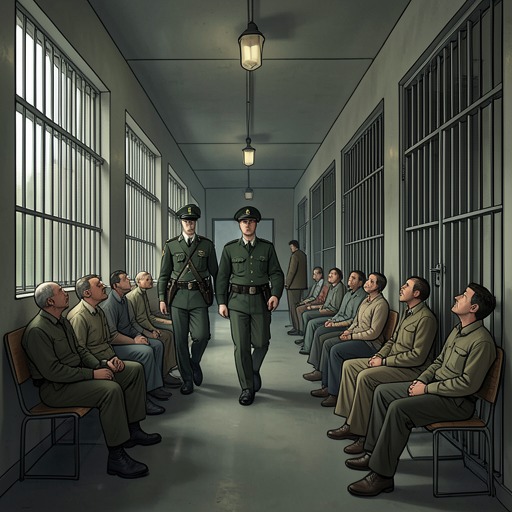
A closed system with no escape
Three SecondsA closed system with no escape is a recurring expression for the prison’s physical enclosure and the narrowing choices that define Piet Hoffmann’s undercover operation. Aspsås Prison confines him behind walls and rules; the danger of exposure makes that enclosure personal, turning each new placement—from the general unit to voluntary isolation—into a temporary response to a threat rather than a way out.
The phrase and the prison
Before entering Aspsås, Hoffmann studies it from outside. From a church tower he maps its buildings and examines the barred windows; he watches the Block B workshop through reinforced glass and metal bars, where inmates work while confined within a seven-meter wall. The phrase gathers force from this contrast between an observer’s map and the place that will soon become his everyday world: knowledge of the prison’s layout does not give him freedom to leave it.
The danger is not only architectural. Hoffmann understands that if he is exposed, burned, or left alone, he will have no choice and will die. An informant exposed inside prison occupies the bottom of its hierarchy, despised alongside other stigmatized prisoners, while murderers and major drug dealers command status and power. A confidential humanitarian pardon, to be approved by the Ministry of Justice, is discussed as an official safeguard; it does not erase the danger of being recognized among the prisoners.
Confinement as routine
Hoffmann’s first entry into Aspsås makes the prison’s control of movement concrete. After the transport bus passes through the gates, guards escort him through registration and search, issue him prison clothing, and leave him in a waiting room. His arrival follows ten days of isolation: for twenty-three hours a day he has been confined to a five-square-meter cell, without visitors or access to newspapers, television, or radio. The expression therefore describes not just a locked perimeter but the regulated use of time, space, and contact.
In Block G, the routines become instructions for living. A principal officer shows Hoffmann where to relieve himself and explains why lock-in is at seven thirty rather than seven thirty-five. The unit will be empty for three hours while its inmates are at the workshop, library, or classroom, but that interval does not make it open: it is time within a schedule whose rules he must learn. Hoffmann has to accept that the cell is now his home.
He also understands that prison life is governed by an informal order as well as official routines. Before the other inmates return, he positions himself in the television corner, where everyone will see him enter the social space. He deliberately takes another prisoner’s favored chair, marked cards, and solitaire game without asking permission. At supper, two older inmates demand to see his papers; Hoffmann lets them ask, while Stefan Lygas and Karol Tomasz Penderecki initially move to intervene. The challenge tests his status, and his response turns the encounter into an effort to establish respect within the prison hierarchy.
Temporary refuge, continuing trap
Hoffmann’s placement in voluntary isolation gives the phrase a particular paradox. When exposure threatens, a prisoner cannot escape far inside a prison but can demand isolation. Ten members of the riot squad enter Block G: six remain to deter further violence, while four escort Hoffmann to the voluntary-isolation unit in Block C. There, the layout resembles an ordinary prison unit, with a wardens’ room, television corner, showers, kitchen, and Ping-Pong table. Its protection comes from separation: residents can move around without meeting prisoners from other units, but the faces within the unit become the only ones Hoffmann will see.
That separation is a limited refuge, not release. Hoffmann describes the danger as a sentence of death that he will nevertheless survive; the unit changes who can reach him without changing the fact that he remains inside the prison system. The same logic links protection to dependence: the walls that keep one threat away also keep him confined.
Protection turned into betrayal
The expression’s bleakest turn comes when Hoffmann realizes that one of the people he counted among his protection and possible escape has burned him. The passage does not resolve who betrayed him, but it makes the trap more intimate: danger has not simply come from the prison’s hostile hierarchy or its architecture, but from within the circle on which his survival depended. The phrase thus links the prison’s closed space to the collapse of trust, as every apparent route to safety can become another part of the enclosure.